
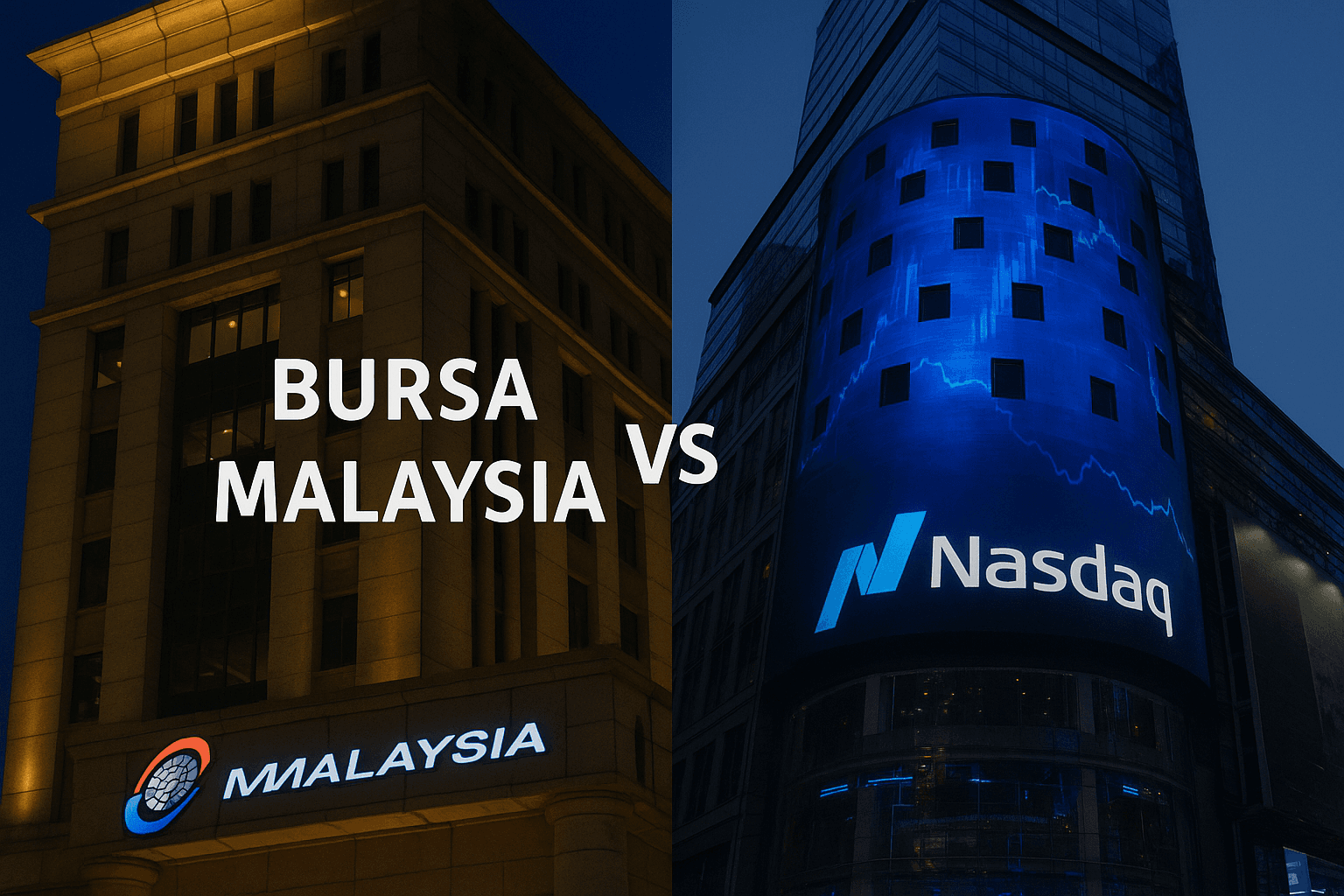
— Structural Differences & Strategic Choices Between Bursa Malaysia and U.S. Markets (Nasdaq/NYSE)
Over the last decade, Malaysian companies have adopted two distinct listing paths.
Some choose the familiar and steady Bursa Malaysia.
Others — particularly technology, advanced manufacturing, green energy, and service-sector companies — are increasingly aiming for U.S. markets such as Nasdaq and NYSE to gain global capital recognition.
Yet the key question remains:
Why can the same company, with the same profitability, have completely different “destinies” in Bursa vs Nasdaq?
The difference lies not in the company itself but in:
- Market structure
- Valuation methodology
- Depth of capital pools
- Investor behaviour
This article breaks down the fundamental differences between Bursa and U.S. markets, supported by real industry case studies showing how:
A company in the same industry can be valued at 5–30x higher simply by listing in the U.S.
01|Market DNA: Regional vs Global Capital Pools
🇲🇾 Bursa Malaysia: Localised & Stability-Oriented
- Investors: EPF, PNB, Khazanah + local retail participants
- Market preference: stability, predictability, dividends
- Valuation style: conservative
- Limited appetite for “growth stories.”
Suitable industries: banks, consumer products, plantations, traditional manufacturing, and mature sectors.
🇺🇸 Nasdaq / NYSE: The Centre of Global Capital
- Global institutions, ETFs, hedge funds, and algorithmic trading
- Valuation based on growth potential, total addressable market, and future expectations
- Deep liquidity
- Investors favour “growth”, “innovation”, and “internationalisation.”
Suitable industries: technology, green energy, AI, automation, circular economy, and innovative manufacturing.
In short: Bursa values the present; the U.S. values the future.
02|Valuation Logic: Defensive vs Growth-Oriented
🇲🇾 Bursa: Focus on current earnings stability
- PE multiples are relatively fixed
- Limited valuation upside for growth companies
- Slow market-cap expansion
Typical EMS/OEM technology manufacturers trade at 10–20x PE.
🇺🇸 U.S. Markets: Powerful valuation upside
- SaaS companies valued at 15–40x revenue
- Green energy & circular economy sectors trade at high PE multiples
- Market cap is driven by growth rate, industry potential, and narrative strength
Thus, U.S.-listed companies can achieve valuations 5–15x higher than those of their Bursa counterparts.
03|Case Study #1: Technology Manufacturing (EMS/OEM)
| Metric | 🇲🇾 VS Industry (6963.MY) | 🇺🇸 Jabil Inc. (NYSE: JBL) |
|---|---|---|
| Market Cap | RM 2 Billion (~USD 400M) | USD 24–25 Billion |
| PE | 12–18x | 25–35x |
| Positioning | Regional EMS Player | Global EMS Leader |
The valuation gap is nearly 2x, while market-cap difference reaches 50x.
04|Case Study #2: Waste Recycling / Circular Economy
| Metric | 🇲🇾 Hiap Huat (0160.MY) | 🇺🇸 Clean Harbors (NYSE: CLH) |
|---|---|---|
| Market Cap | RM 50 Million+ | USD 9 Billion+ |
| PE | Low | 25–40x |
| Market Label | Traditional Industrial | ESG + Circular Economy |
In Bursa, waste recycling is seen as “traditional industrial”.
In the U.S., it represents “green energy, ESG, sustainability”.
Labels shape perception → Perception shapes valuation → Valuation shapes market cap.
05|Liquidity: The Great Divide
🇲🇾 Bursa Malaysia: Low liquidity for most SMEs
- 70% of listed companies have daily turnover below RM 500k
- Many SMEs trade below RM 50k/day
Leading to:
- Suppressed valuations
- Limited fundraising capability
- Higher price volatility
- Slow market-cap growth
🇺🇸 U.S. Markets: Natural global liquidity
Even small-cap stocks enjoy:
- High-frequency trading
- ETF participation
- Global retail + institutional investors
- Market-making support
06|Fundraising Ecosystems: Weak vs Robust
🇲🇾 Bursa’s challenges:
- Restrictions on placement discounts
- Limited institutional demand
- Sensitivity toward share issuance
- Fundraising capacity limited by market cap
Many companies fail to complete meaningful post-IPO fundraising after 5–10 years.
🇺🇸 U.S. fundraising ecosystem:
- PIPE
- ATM (At-the-Market) offerings
- Strong underwriter network
- Investors are more accepting of issuance
Ideal for fast-growing companies needing recurring capital.
07|Regulatory Requirements & Credibility
🇲🇾 Bursa: balanced, business-friendly
Suitable for local and mature industries.
🇺🇸 U.S. markets: stringent but high-value
Includes:
- SEC reporting
- Sarbanes-Oxley internal controls
- International accounting standards
Benefits:
- Global recognition
- Valuation premium
- Better access to institutional & global partners
08|Ultimate Comparison
| Dimension | Bursa Malaysia | Nasdaq / NYSE |
|---|---|---|
| Market Positioning | Regional, conservative | Global, growth-oriented |
| Investors | Local institutions, retail | Global institutions, ETFs |
| Liquidity | Weak | Strong |
| Valuation | Defensive | High-growth premium |
| Fundraising | Limited | PIPE/ATM/SPAC-friendly |
| Compliance Cost | Moderate | Higher, with global credibility |
| Best for | Mature sectors | Technology & growth sectors |
09|Conclusion: Listing Is a Strategic Decision
Bursa is ideal for companies that are:
- Stable
- Dividend-focused
- Locally oriented
- Operating in mature, predictable sectors
U.S. markets are ideal for companies that:
- Seek high growth
- Operate in global markets
- Are in technology/green energy/circular economy
- Need continuous fundraising
- Want global institutional visibility
Listing is not a ceremony — it is a strategic bridge to capital.
Different markets create different valuation realities and growth trajectories.